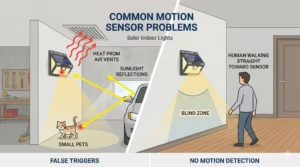
Best solar lights for indoor use including solar lights for garages,barn,rooms and kitchen indoor lights.
Solar lighting technology has improved dramatically. It’s no longer just for outdoor garden lights and security floods. Now, solar lights can work inside your home through “split-systems” where the solar panel sits outside but the light works inside.
This guide looks at the best solar indoor lights you can buy on Amazon right now. We’ll cover how they work and which ones are best for different rooms in your home.
- Best indoor solar light for garage, sheds and workshops
- Best indoor solar lights for kitchen
- Best indoor solar lights for living room
- Best solar indoor lights for Hallways
- Best indoor solar light for Bedroom
1. How Solar Indoor Lights Work
1.1 The Basic Setup
Solar indoor lights have three main parts:
Solar Panel: Goes outside on your roof or wall (1W–10W). Must be outside because windows block too much sunlight – they can cut power by 30-50%.
Cable: Connects the outside panel to the inside light. Length matters: 9-foot cables only work near walls; 16-foot cables let you put lights in the middle of rooms.
Battery: Stored inside the light fixture. Stays warmer in winter and cooler in summer than outdoor lights, so it lasts longer.
1.2 Brightness Needed by Room
| Room Type | What You Need | Brightness Level |
| Work spaces | Bright, clear light | 500–1500+ lumens |
| Hallways & stairs | Quick turn-on, wide coverage | Motion sensor, wide beam |
| Living rooms & bedrooms | Soft, warm light | Warm color, no glare |
1.3 Battery Types Explained
- Ni-MH batteries: Older technology but very reliable. Handles hot and cold well. Used in Gama Sonic lights. Lasts 3-5 years.
- LiFePO4 batteries: Best quality. Lasts 2000+ charges (5-7 years). Found in expensive lights like Intelamp. Worth the cost for permanent setups.
- Li-ion batteries: Middle option. Good power but wears out faster (2-3 years). Found in most mid-price lights.
2. Utility and Workspace Lighting:
Garages, Sheds, and Workshops:
The most demanding application for indoor solar lighting is the utility space. Whether it is a detached garage, a woodworking shop, or a garden shed, these spaces require high-intensity, shadow-free illumination that mimics the output of fluorescent shop lights.
2.1 Multi-Mode Solar Motion Shed Light (4-Head Design)
The system includes five lighting modes designed for both night and daytime use.
- Mode 1: Dim to bright when motion is detected at night
- Mode 2: Off to bright when motion is detected at night
- Mode 3: Constant ON during nighttime
- Mode 4: Off to bright when motion is detected in daytime
- Auto Mode: Stays on through the day and automatically switches to motion Mode 4 when battery drops to about 50 percent
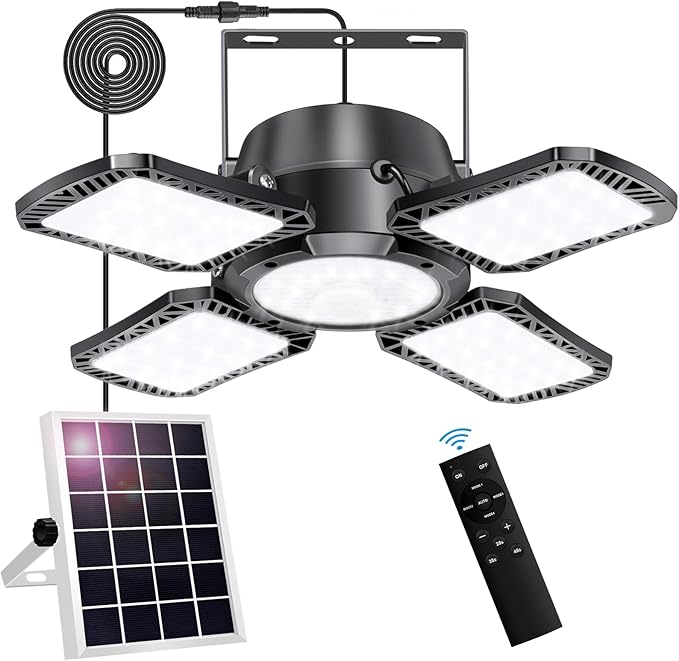
Multi-Mode Solar Motion Shed Light
Why We Love It (Pros & Cons)
Pros
- ✅Multiple lighting modes
✅Works day & night
✅Flexible split design with long wire
✅Remote control
✅Adjustable panels
✅Bright LEDs
✅Waterproof and easy to install.
Cons
- ❌Limited daytime functionality
❌Performance depends on sunlight
Motion delay timing can be adjusted to 25, 35, or 45 seconds for motion-based modes. This gives better control over battery usage and response time depending on how often the shed is accessed.Important behavior note: when the solar panel is exposed to sunlight, night modes only activate in darkness. For daytime operation, Mode 4 and Auto are used.
2.2 The Modern Challenger: Hykolity Solar Powered Shop Light
For users requiring broader linear illumination and automated operation, the Hykolity Solar Powered Shop Light offers a compelling alternative, borrowing form factors from commercial lighting.

Photometrics and Smart Control
Unlike the spot-style heads of the Gama Sonic, the Hykolity unit resembles a 3-foot or 4-foot LED batten. This linear form factor spreads light over a wider area, reducing glare and creating a more uniform wash of light ideal for parking garages or general storage.
Power and Output: It is marketed as a 100W equivalent with a 17W power draw, suggesting a significantly higher peak brightness capability than standard shed lights.
Sensor Integration: A distinct advantage is the built-in motion sensor. In a garage setting, carrying groceries or tools often makes manual switching difficult. The Hykolity detects motion up to 8 feet away (when mounted at 10 feet) and activates automatically.
Waterproofing: Rated IP65, the fixture itself is sealed against dust and moisture. This is particularly relevant for unconditioned spaces like barns or carports where humidity can corrode non-sealed electronics.
3. Kitchen and Culinary Zones: High-CRI Task Lighting
Illuminating a kitchen with kitchen solar power lights presents unique challenges. Kitchens require high visibility for safety (knife work, reading recipes) and high Color Rendering Index (CRI) to accurately judge food quality. Standard “security” solar lights often emit a ghostly blue light (7000K+) that makes food look unappetizing.
3.1 NIORSUN Solar Indoor and Outdoor Pendant Lights

Brightness and Coverage
- Up to 800 lumens total (2 × 400 lm lamps)
- Lights about 194 to 237 sq ft
- Dual-lamp design gives wider, more even coverage
- Each lamp can be controlled separately
Color Temperature Options
- 3 selectable modes: 3000K, 4000K, 5000K
- Switch color tone anytime with the remote
Controls and Modes
- Remote control for on/off, brightness, color, and modes
- Manual mode or Dusk to Dawn auto mode
- Built-in timers: 3h, 5h, 8h
Power and Runtime
- Large solar panel with 2 × 4000 mAh batteries
- Charging: 6 to 8 hours full sun
- Runtime: up to 16 hours when fully charged
Installation and Build
- Split design with 16.4 ft cable per lamp
- Added metal hanging ring to reduce cable strain
- IP65 waterproof for indoor and outdoor use
- Optional extension cable available
Best suited for sheds, gazebos, garages, patios, and other off-grid spaces where flexible solar lighting is needed.
3.2 Under-Cabinet and Counter Lighting:
For lighting under cabinets where overhead lights create shadows, the EZVALO Motion Sensor Cabinet Lights offer a simple stick-on solution.
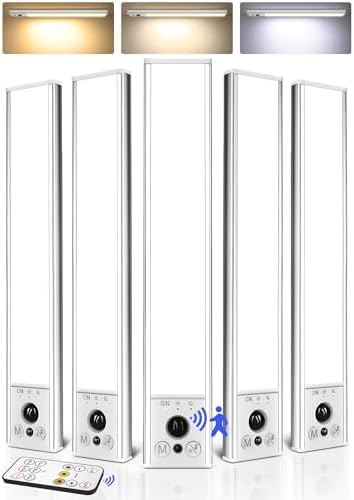
What They Are: Rechargeable aluminum bar lights that attach under cabinets with magnets or sticky strips.
Motion Sensing: Wave your hand to turn them on, no touching needed when your hands are dirty or wet. Senses motion from 12 feet away and turns off after 20 seconds automatically.
Battery Life: One charge lasts 16-50 days with motion mode (or 13.5 hours if left on constantly). Takes 4.5 hours to fully recharge using a USB-C cable.
Light Options:
- Choose from 3 color temperatures: warm (3000K), natural (4500K), or bright white (6500K)
- Adjust brightness from 10% to 100%
Three Smart Modes:
- Night Motion: Only turns on in the dark
- All-Day Motion: Turns on anytime it senses movement
- Always On: Stays lit for cooking or detailed work
Easy Setup: Sticks to metal surfaces with built-in magnets, or use the included adhesive strips for other surfaces. No tools or wiring needed.
Light Quality: Designed for kitchens with smooth, even light that doesn’t create glare on shiny countertops better than harsh outdoor lights.
4. Living and Social Spaces: Aesthetic and Ambient Illumination
In living rooms, dining rooms, and dens, the mechanical appearance of utility lights is unwelcome. Here, the requirement shifts to “warmth” (3000K color temperature), diffusion, and fixture design that complements interior decor.
4.1 Decorative Pendants: Pearlstar and Kyson
The Pearlstar and APILAB brands dominate the aesthetic solar niche, offering fixtures that look like traditional hardwired lamps.
1. Pearlstar Vintage Lanterns: These feature retro metal cages and Edison-style filaments.

- 【Elegant Vintage Patio Decor】Designed with a retro look and warm soft glow, these decorative solar lanterns create beaut…
- 【Solar Powered & Auto Dusk to Dawn】Powered entirely by sunlight, these outdoor solar lights automatically charge during …
- 【Decorative Hanging & Tabletop Lantern】Featuring a durable handle, these solar lamps can be easily hung on trees, pergol…
Lumen Output: Typically lower (approx. 30-60 lumens), intended for mood lighting rather than reading. They create a “filament” glow that adds character to a room.
Use Case: Best suspended over a dining table or in a reading nook where high brightness is not required, but atmosphere is essential.
2. APILAB Indoor Solar Barn Lights: These strike a balance between style and function.

Design: Often feature a classic “barn light” metal shade which directs all light downward, increasing effective illuminance on a table surface compared to an omnidirectional cage light.
Control: Includes a pull cord and remote, mimicking the interaction of a standard indoor lamp.
4.2 Floor Lighting: The Rise of Solar Floor Lamps
A newer category is the solar-powered floor lamp.
Hybrid Functionality: These lamps are cordless and weather-resistant (IP44+). They are designed to live on a patio but can be brought indoors in the evening.
Charging Dynamic: Because they lack a separate cable-connected panel, the entire lamp must be placed in the sun (e.g., near a south-facing window or outdoors) to charge.
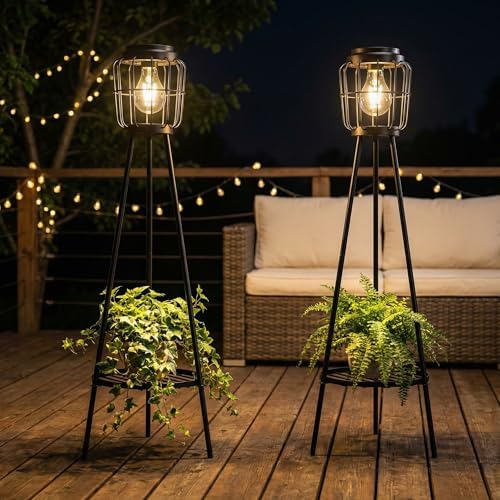
Aesthetics: They offer RGB color changing and warm white modes, making them versatile for parties or quiet evenings.
5. Transit and Safety: Hallways, Staircases, and Bathrooms
In transitional spaces, the primary goal is safety. Lights must activate instantly upon motion detection to prevent falls, but need not run continuously.
5.1 High-Power Entryway: Intelamp Motion Sensors
For a large foyer or a hallway connecting a garage to the house, a more powerful single-source light is often better.
Intelamp Separate Panel Sensor Lights: With a 1200-lumen output and 270-degree wide-angle dispersion, a single Intelamp unit mounted above a doorframe can illuminate an entire entry hall.

Split Installation: The panel mounts outside the door (drilled through the header or frame), ensuring the battery remains topped up even in winter, while the motion sensor monitors the indoor space.
6. The Bedroom: Circadian Rhythm and Reading
Bedroom lighting must be conducive to sleep hygiene. High-kelvin blue light suppresses melatonin; therefore, solar lights in this zone must offer warm (2700K-3000K) options or dimming capabilities.
6.1 Bedside Reading and Solar String Lights
Dedicated solar bedside lamps are rare due to the panel placement issue. The optimal solution is often a high-quality USB-C rechargeable lamp paired with a window-mounted solar charger.
For soft, non-functional lighting, solar string lights (e.g., Brightech Ambience Pro) can be draped over headboards or around windows.


Charging: The small panel can be suction-cupped to the bedroom window.
Effect: They provide a soft, warm glow sufficient for navigation without waking a partner.
7. Critical Evaluation Factors for Consumers
When selecting from the myriad options on Amazon, specific technical criteria delineate professional-grade equipment from disposable novelties.
7.1 Battery Technology: The Core of Longevity
The battery is the failure point of most solar lights.
LiFePO4 (Lithium Iron Phosphate): Found in top-tier units (e.g., Intelamp). These withstand high temperatures and offer 2000-5000 charge cycles. A light with this battery can last 5-7 years.
Li-ion (Lithium-Ion): Standard in mid-range lights (e.g., Hykolity). Good density but degrades faster (300-500 cycles), typically lasting 2-3 years.
Ni-MH: Extremely robust and safe, but heavy and less energy-dense. Good for wide temperature ranges.
7.2 The “Split” Requirement
For indoor use, never rely on “window sill” charging for primary lighting. Window glass cuts solar energy by up to 50%. A functional indoor light must have a remote panel with a cable length of at least 9-15 feet to allow the panel to sit outdoors in direct sun.
7.3 IP Ratings and Weatherproofing
While the light is indoors, the panel is outdoors. Ensure the panel and the cable connector are rated IP65 (dust tight, water jet resistant). IP44 is insufficient for panels exposed to heavy rain or snow.