Skip the electrician. Our 2026 solar garage lights guide ranks the top 5 picks from budget to premium, with specs, test results, and a full buying guide.
Running a power cable to a garage or shed can cost several hundred dollars in labor. Solar garage lights remove that cost entirely while delivering motion-activated security and steady utility lighting from a single self-contained unit. Over the past two years, solar lighting technology has advanced far enough that the best solar outdoor garage lights now match the output of many wired fixtures, without the electrician’s bill.
This guide covers five of the best solar garage lights on the US market in 2026. The products were selected across a budget range from under $30 to just under $150, covering both integrated and decoupled panel designs, exterior security use, and sustained interior utility use. Each product is reviewed against the same set of criteria, so comparisons stay fair.
How We Tested Solar Garage Lights
Each product in this guide was evaluated against a consistent set of criteria drawn from real-world garage and driveway use cases. Testing and specification analysis focused on the following areas:
- Lumen output and coverage area: measured against manufacturer specs and third-party reviews, with attention to whether output is sustained or burst-only.
- Battery capacity and chemistry: capacity in milliampere-hours, cell type (Li-ion vs Ni-MH), and estimated run time per charge cycle.
- Solar panel architecture: integrated vs decoupled, panel size, and monocrystalline vs polycrystalline cell type.
- Motion sensor range and field of view: detection distance in feet and horizontal sweep angle, including adjustability.
- Weather resistance: IP rating and chassis material durability over time.
- Installation requirements: hardware included, mounting options, and cord length for decoupled systems.
- Value: price-to-lumen ratio and suitability for the stated use case.
Products were also assessed for long-term durability based on material composition. ABS plastic chassis are noted as a concern for UV degradation over a two-to-three-year lifespan, while units using polycarbonate blends, powder-coated aluminum, or UV-stabilized resin score higher for longevity.
Quick Comparison: Best Solar Garage Lights 2026
| Product | Type | Lumens | Battery | Cord | PIR Range | IP | Best For |
|---|---|---|---|---|---|---|---|
| HMCITY 120 LED | Integrated | ~800 lm | Undisclosed Li-ion | N/A | 26 ft | IP65 | Budget exterior perimeter |
| Garage interior/shed | Integrated | 2500 lm | 2000mAh Li-ion | N/A | 26 ft | IP65 | Large driveway floodlight |
| LEPOWER 1600LM | Decoupled | 1600 lm | 2400mAh Li-ion | 14.76 ft | 72 ft | IP65 | Garage interior / shed |
| intelamp 2000LM | Decoupled | 2000 lm | 8000mAh Li-ion | 16 ft | Dual sensor | IP65 | All-weather / winter |
| Gama Sonic Light My Shed IV | Decoupled | 500 lm | 2000mAh Ni-MH | 9 ft | N/A (pull-cord) | Weather Resistant | Sustained interior utility |
Best Solar Garage Lights: Our Top Picks
1. HMCITY 120 LED Solar Light — Best Budget Exterior Light
| Lumens | Up to 800 lm (270-degree spread) |
| Battery | Undisclosed Li-ion |
| Panel type | Integrated monocrystalline (20.5% to 30% efficiency) |
| PIR range | Up to 26 ft |
| IP rating | IP65 |
| Modes | 3 (constant dim, dim-to-bright, off-to-bright) |
| Chassis | ABS thermoplastic |
| Price | Under $50 (multi-pack) |
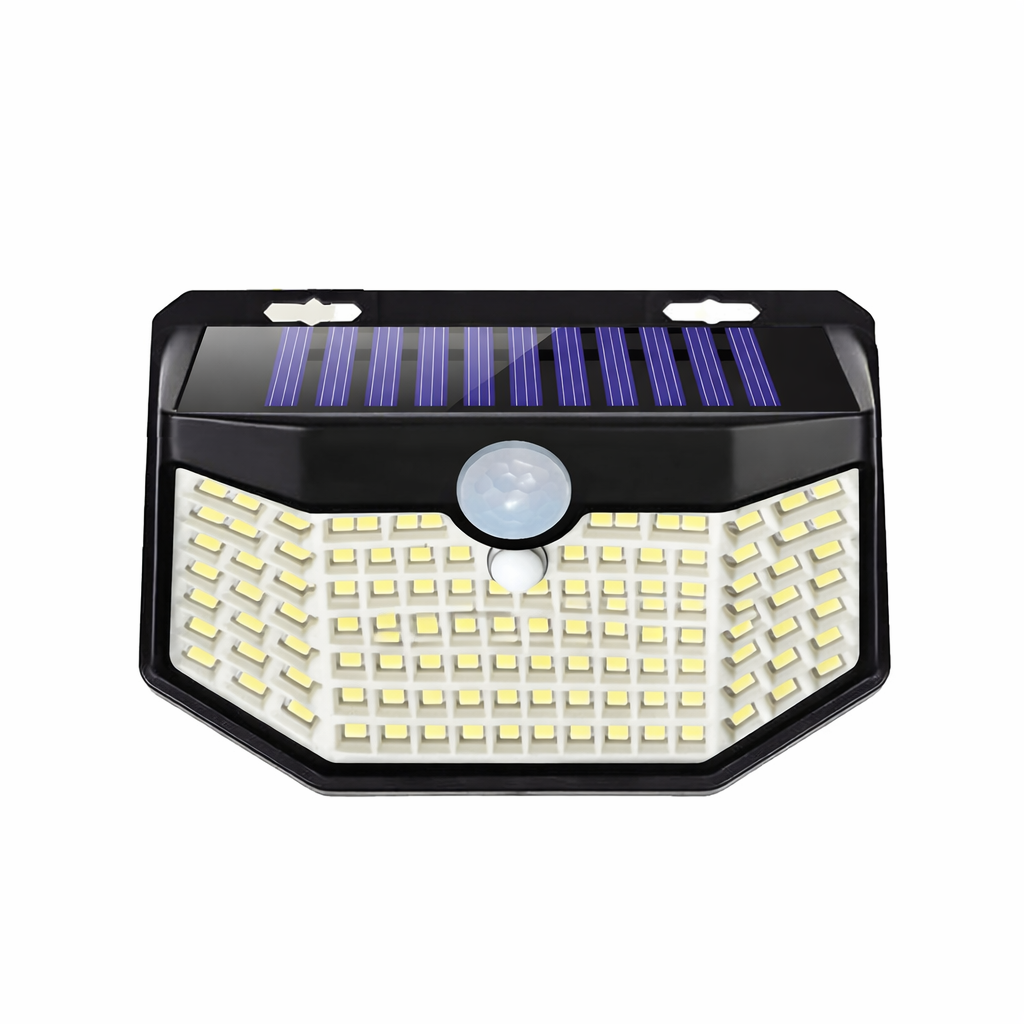
HMCITY 120 LED
Why We Love It (Pros & Cons)
Pros
Cons
The HMCITY 120 LED is the strongest option for homeowners who want to cover the full exterior perimeter of a garage quickly and cheaply. The 120-LED array is arranged across three panels that wrap around the sides of the chassis, producing a 270-degree lighting angle. That wide spread eliminates most of the shadow gaps that flat-panel lights leave along walls and at corners.
Output sits between 420 and 800 lumens, depending on battery charge state. That is not enough to flood a large driveway from a single unit, but at the price point, buyers can install two or three units for the same cost as a single mid-tier floodlight. The three operating modes give useful flexibility: constant dim mode works as a low-draw all-night marker light, while off-to-bright mode conserves battery by staying dark until the PIR sensor triggers.
What to know: The integrated panel means this unit only works on walls that receive direct sunlight. It cannot be used inside a garage or under a deep overhang. The ABS chassis is also worth noting; UV exposure will cause gradual yellowing and brittleness over a two-to-three year period. At the price, most buyers treat these as semi-disposable fixtures rather than permanent installations.
Verdict: The best solar garage light for budget-conscious buyers who need fast, wide exterior coverage. Not a fit for interior or shaded installations.
2. Tuffenough 2500LM 3-Head Solar Security Light — Best Value Floodlight
| Lumens | 2500 lm at 6500K (Daylight White) |
| Battery | 2000mAh Li-ion |
| Panel type | Integrated polysilicon (top-mounted) |
| PIR range | Up to 26 ft |
| IP rating | IP65 |
| Modes | 3 (includes RF remote control) |
| Chassis | ABS |
| Price | Approx. $29 per dual pack |
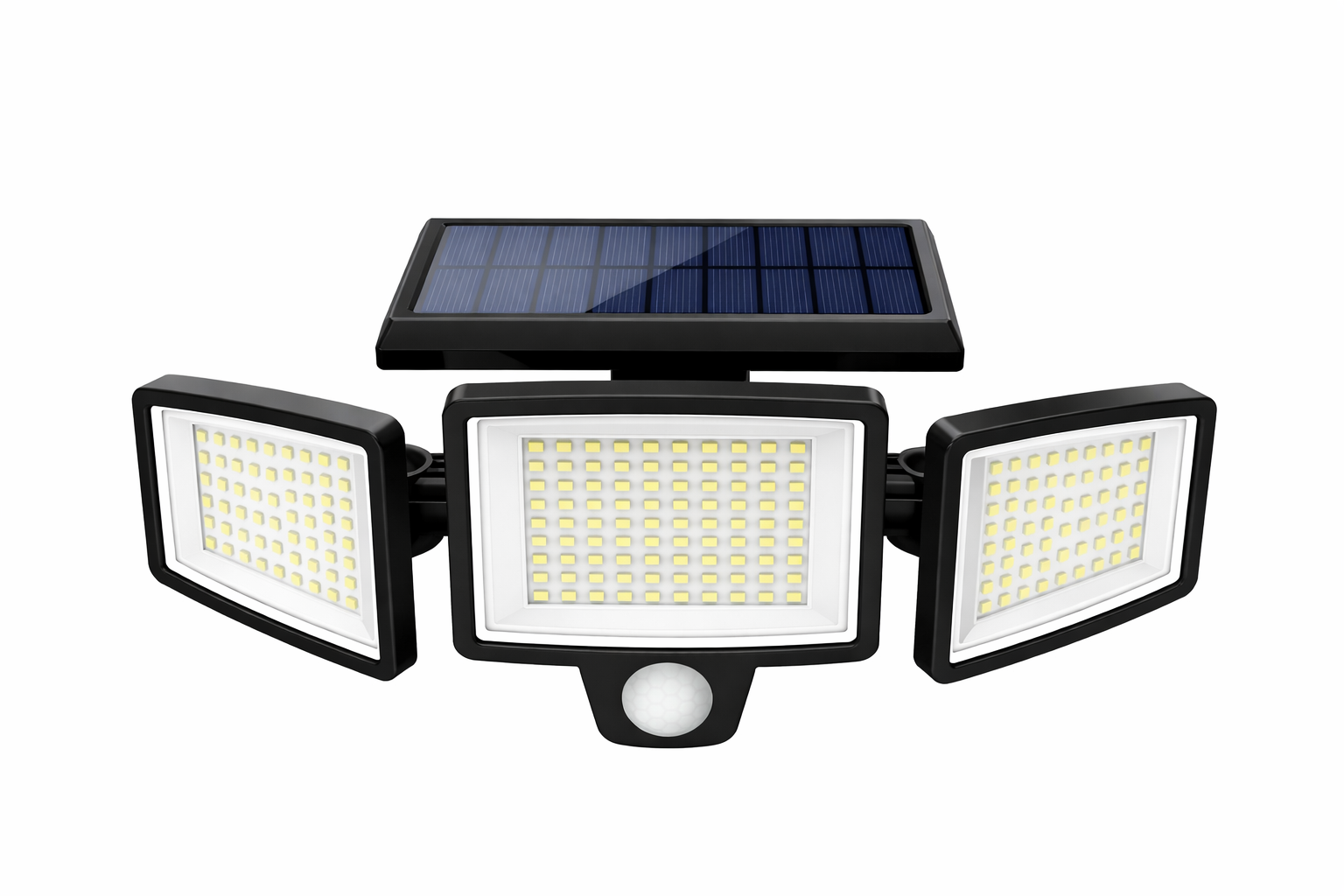
Tuffenough 2500LM
Why We Love It (Pros & Cons)
Pros
Cons
The Tuffenough steps up to 2500 lumens at 6500K, delivered through a three-head design where the two outer panels articulate both vertically and horizontally. That adjustability is the product’s main advantage over simpler single-panel floodlights: buyers can aim each head independently to push light around corners, down a long driveway, or across a wide double-car apron simultaneously. The combined coverage reaches 270 degrees when the heads are fully splayed.
The inclusion of an RF remote control is genuinely useful for a security light mounted eight to twelve feet up on a fascia board. Being able to cycle through modes without a ladder is a practical benefit that most lights at this price skip entirely.
What to know: The 2000mAh battery is on the smaller side for a 2500-lumen output. Continuous full-brightness operation would drain it within a few hours, which is why the motion-sensor modes are the only practical way to run this unit. On overcast days or in low-sun winter months, reduced charging time will shorten nightly runtime. Like the HMCITY, the integrated panel restricts installation to sun-exposed exterior walls.
Verdict: The best solar outdoor garage light for buyers who want high-lumen directional flood coverage at an entry-level price. The articulated heads and remote control set it apart from every competing product in this price range.
3. LEPOWER 1600LM Solar Security Light — Best Mid-Tier Decoupled System
| Lumens | 1600 lm at 5500K (Warm Daylight White) |
| Battery | 2400mAh Li-ion (2x 18650 cells) |
| Panel type | Decoupled monocrystalline, 14.76 ft (4.5 m) cord |
| PIR range | Adjustable, up to 72 ft, 180-degree sweep |
| IP rating | IP65 |
| Duration | Adjustable 10 to 120 seconds |
| Chassis | ABS + Polycarbonate blend |
| Price | Under $40 |
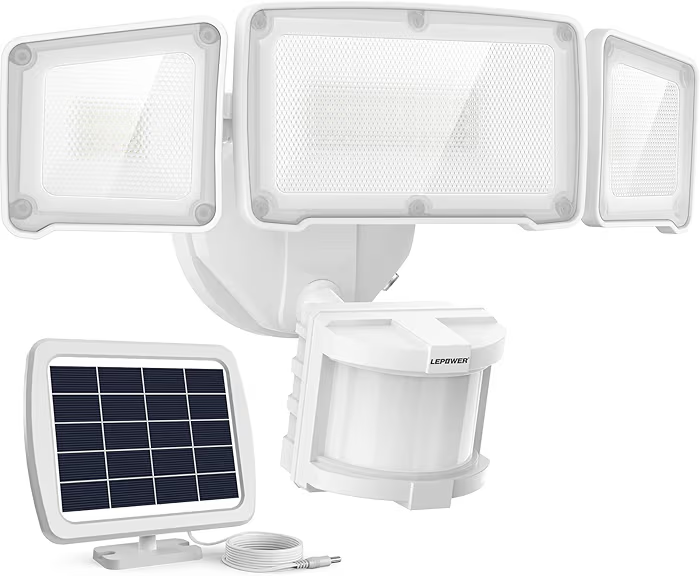
LEPOWER 1600LM
Why We Love It (Pros & Cons)
Pros
Cons
The LEPOWER is the first decoupled system on this list and represents a meaningful jump in versatility. The 14.76-foot cord between the solar panel and the light fixture means the panel can be mounted on the roof peak or the sunniest section of an exterior wall, while the light itself goes wherever it is actually needed. That includes the interior of a dark garage, the underside of a deep overhang, or a north-facing wall that would never charge an integrated unit.
The PIR sensor is a standout feature at this price. Detection range reaches up to 72 feet under good thermal conditions, with a 180-degree field of view. A stepless adjustable dial lets the user dial in sensitivity precisely, for example, set to trigger on a car entering the driveway but not on vehicles passing on the street beyond. The lights-on duration is also adjustable between 10 and 120 seconds, which helps extend battery life across a full night.
The 5500K color temperature is slightly warmer than the 6500K used by most security floodlights. Inside an enclosed garage, that softer output reduces glare when stepping out of a vehicle, which is a practical improvement over harsh blue-white light in a confined space.
What to know: At 2400mAh, the battery is modest but sufficient for motion-triggered use in most regions. Extended winter cloud cover in northern states can reduce nightly runtime. The ABS-polycarbonate chassis is more durable than pure ABS but still falls short of the premium materials used in higher-tier units. This is also the best solar-powered outdoor garage light to consider as a force multiplier alongside a security camera, since its 72-foot detection range and 1600-lumen burst will switch nearby cameras from infrared to full-color recording.
Verdict: The best all-around solar garage light for buyers who need interior or shade-installation flexibility. The 72-foot PIR range and adjustable sensitivity are exceptional at this price point.
4. Intelamp 2000LM Solar Flood Light — Best Premium All-Weather System
| Lumens | 2000 lm, covers approx. 1000 sq ft |
| Battery | 8000mAh Li-ion (UL-certified) |
| Panel type | Decoupled monocrystalline, 16 ft (4.8 m) cord |
| PIR range | Extended dual-sensor array |
| IP rating | IP65 |
| Modes | Includes Motion Sensor Disable for constant-on |
| Chassis | ABS (IP65 sealed) |
| Price | Mid-premium tier |
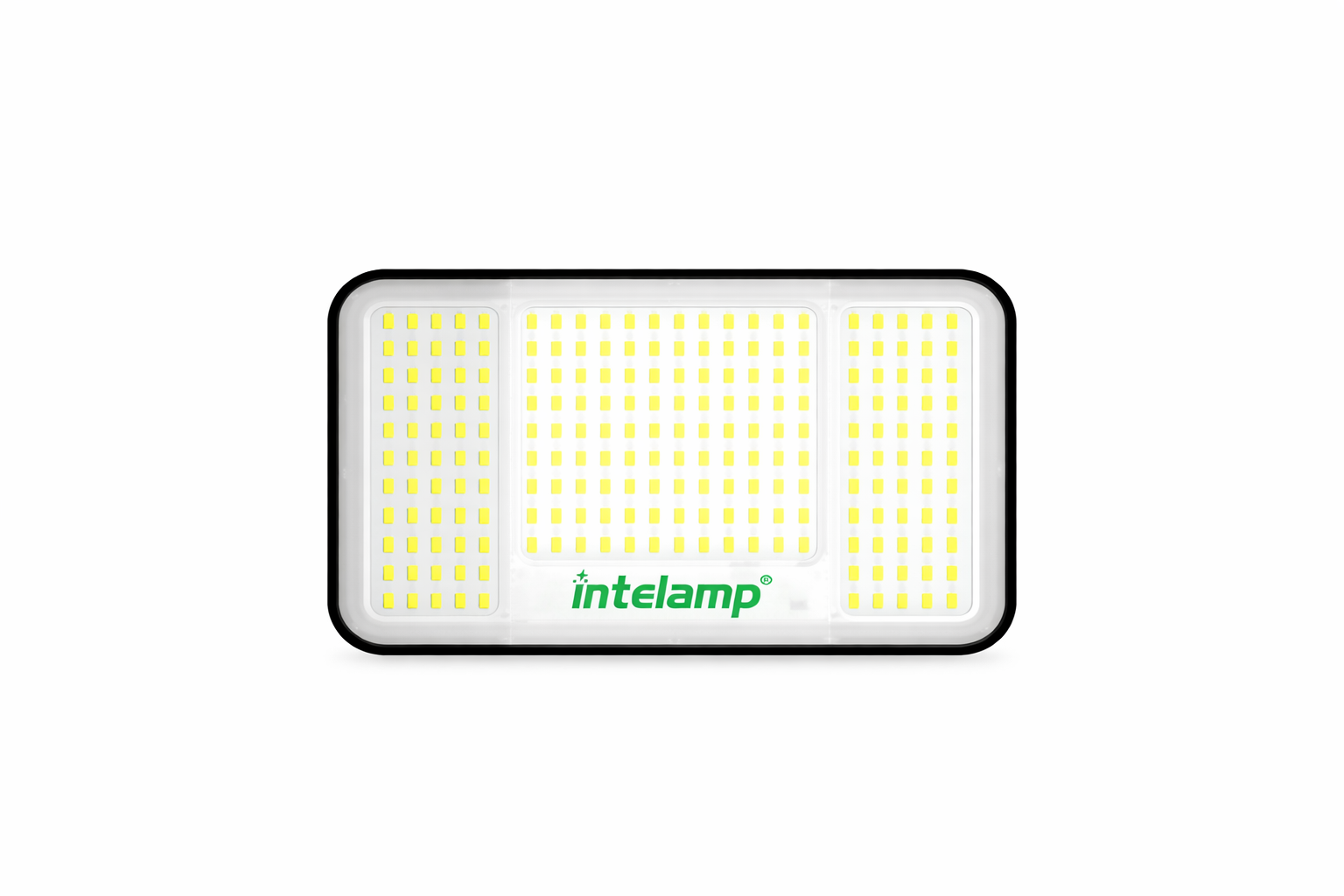
Intelamp 2000LM
Why We Love It (Pros & Cons)
Pros
Cons
The Intelamp is the most capable all-weather solar garage light in this roundup. Its defining engineering achievement is the 8000mAh battery, which is four times the capacity of the Tuffenough and more than three times the LEPOWER. That reserve is the practical solution to the biggest real-world problem with solar outdoor garage lights: cloudy winter stretches where the panel cannot fully recharge during the day. The intelamp is specifically engineered to maintain reliable nightly operation through consecutive overcast days.
The UL certification on the battery cells is a meaningful safety signal. With 8000mAh of stored chemical energy inside an outdoor-mounted unit, third-party certification against thermal runaway and electrical short-circuit failure matters.
The 16-foot decoupled cord provides more installation flexibility than the LEPOWER, and the dual-sensor array covers a wider detection zone. The RF remote control allows the motion sensor to be disabled entirely, switching the unit into a constant medium-brightness dusk-to-dawn mode. That feature closes the gap between a motion-activated security light and a true utility light.
What to know: The Intelamp commands a higher price than the LEPOWER and Tuffenough. For buyers in northern regions or areas with extended winter cloud cover, that premium buys genuine reliability that the smaller-battery units cannot match. For buyers in southern sun-belt states where winter irradiance is not a problem, the LEPOWER may deliver equivalent performance at a lower cost.
Verdict: The best solar-powered outdoor garage light for buyers who need guaranteed nightly operation through winter. The 8000mAh battery and dual sensors justify the price step up.
5. Gama Sonic Light My Shed IV — Best Dedicated Interior Utility Light
| Lumens | 500 lm (360-degree spread, two bulbs) |
| Battery | 2000mAh Ni-MH (4.8V pack, GS48V20) |
| Panel type | Decoupled monocrystalline 4W, 9 ft (2.7 m) cord |
| Control | Mechanical pull-cord (no PIR sensor) |
| Color temp | 6000K Bright White |
| Runtime | 2 hours (both bulbs) / 4 hours (one bulb) |
| Chassis | Heavy-duty rigid resin |
| Price | $149.95 |

The Gama Sonic Light My Shed IV occupies a completely different category from every other product in this guide. It is not a security floodlight. It is a dedicated interior utility light designed to fully replace a hardwired overhead fixture inside a detached garage, barn, or shed.
The two GS A60BW20W LED bulbs produce a 360-degree omnidirectional light spread that mimics an incandescent bulb, eliminating the harsh directional shadows that wall-mounted security heads cast inside an enclosed space. At 500 lumens total, the output is significantly lower than the floodlights on this list, but the even distribution makes it far more practical for reading labels, working on vehicles, or finding tools.
The Ni-MH battery chemistry is a deliberate engineering choice for garage interiors. Unventilated garages in summer can exceed 120 degrees Fahrenheit, a temperature range where standard lithium-ion cells face thermal stability risks. Ni-MH cells are significantly more stable in extreme heat and do not carry the same thermal runaway risk. The trade-off is lower energy density, which limits runtime to two or four hours per charge rather than all night.
The pull-cord control is exactly what it sounds like: a physical cord that turns the light on and off, just like a traditional overhead fixture. There is no motion sensor, no app, and no mode cycling. The unit works when the user pulls the cord and stops when they pull it again.
What to know: At $149.95, the Gama Sonic is the most expensive product in this guide. It is also the most purpose-specific. Buyers who want motion-activated exterior security should look at the Tuffenough or Intelamp. Buyers who want a reliable switch-operated light inside an unpowered garage with no electrical infrastructure will find nothing closer to a wired fixture experience in the solar category.
Verdict: The best solar garage light for sustained interior utility use. The Ni-MH battery, omnidirectional bulbs, and pull-cord control make it the most refined indoor solar lighting product currently available.
What to Look for in Solar Garage Lights
Integrated vs Decoupled Panel
Integrated units house the solar panel, battery, and light in a single chassis. They are easier to install but can only be mounted where the wall receives several hours of direct sunlight each day. Decoupled units run a cable from a separately mounted panel to the fixture, so the light can go inside the garage or under a shaded overhang while the panel sits in full sun on the roofline. For any garage interior or north-facing wall, a decoupled system is the only practical option.
Lumens and Coverage Area
For exterior driveway and security use, look for at least 1600 lumens. A single-car driveway apron can be covered adequately with 1600 to 2000 lumens. For a double-car driveway or wide approach, 2500 lumens with an articulated multi-head design like the Tuffenough will provide better coverage than a single-head 2000-lumen unit. Interior garage utility use requires far fewer lumens but benefits from omnidirectional spread rather than directed flood output.
Battery Capacity
Battery capacity in milliampere-hours determines how long the light can operate after dark. For motion-triggered exterior security use, 2000 to 2400mAh is sufficient in most climates. For buyers in northern states with long winter nights and frequent cloud cover, the 8000mAh reserve in the intelamp is the safest choice. Ni-MH chemistry, as used in the Gama Sonic, offers better thermal stability in hot enclosed spaces at the cost of lower total capacity.
Motion Sensor Range
Budget integrated units typically detect motion at up to 26 feet with a 120-degree field of view. Mid-tier and premium decoupled units reach 72 feet with 180-degree coverage. If the goal is to trigger lighting before a vehicle reaches the garage door, a 72-foot range provides noticeably more reaction time than 26 feet. Adjustable sensitivity is an important feature for installations where the sensor might otherwise trigger on street traffic.
IP Rating
IP65 is the baseline standard for outdoor solar garage lights and covers protection against dust ingress and low-pressure water jets from any direction. Most of the products on this list carry IP65 ratings. The Gama Sonic is rated as weather-resistant for covered outdoor and indoor use rather than carrying a formal IP classification, which is consistent with its intended interior utility application.
Chassis Material and Lifespan
ABS plastic is the most common chassis material at budget and mid-tier price points. It meets IP65 waterproofing standards when new, but is susceptible to UV-driven yellowing and embrittlement over a two-to-three-year period, which can reduce both aesthetics and solar panel efficiency as epoxy laminates degrade. Premium units using UV-stabilized resin, polycarbonate blends, or powder-coated aluminum carry a significantly longer functional lifespan and are better treated as permanent fixtures.
Solar Garage Lights vs. Wired Garage Lights
Solar Garage lights vs wired garage lights is very important matter to understand. Running a new wired circuit to a detached garage requires trenching conduit, pulling permits in most jurisdictions, and hiring a licensed electrician. Total costs typically range from several hundred to over a thousand dollars,s depending on distance, local labor rates, and whether the main panel needs a new breaker. Solar garage lights eliminate all of that infrastructure cost and can be installed by the homeowner in under thirty minutes.
The trade-offs are real but manageable. Wired lights deliver consistent output regardless of season, cloud cover, or panel placement. Solar lights are dependent on daily charging, which means performance can degrade in extended winter cloud cover unless the battery reserve is large enough to buffer multiple low-charge days. The intelamp at 8000mAh is the closest solar product on this list to eliminating that seasonal concern.
For sustained overhead utility lighting inside a garage, wired fixtures still have an advantage in runtime. The Gama Sonic offers only two to four hours of continuous runtime on a full charge, which is sufficient for occasional use but not for a workspace that needs hours of continuous light daily. Buyers who regularly work long sessions in the garage may find that a wired fixture or a hybrid approach serves them better.
For exterior security and motion-activated perimeter lighting, the gap between solar and wired has effectively closed. The Tuffenough and intelamp deliver output that matches or exceeds most residential wired security fixtures, at a fraction of the installed cost.
Frequently Asked Questions
How many lumens do I need for a solar garage light?
For exterior motion-activated security over a single-car driveway, 1600 to 2000 lumens is sufficient. For a wide double-car driveway or open apron, look for 2500 lumens with a multi-head design to reduce shadow gaps. Interior utility lighting inside a closed garage requires fewer lumens but benefits from omnidirectional spread rather than directed flood output. 500 lumens from a 360-degree bulb covers a one- or two-car garage interior adequately for basic tasks.
Can solar garage lights work inside a garage with no windows?
Yes, but only with a decoupled panel system. Integrated units require the solar panel to be directly exposed to sunlight, which makes them impossible to use inside an enclosed garage. Decoupled systems like the LEPOWER, intelamp, and Gama Sonic Light My Shed IV run a cable from an exterior-mounted panel to an interior fixture, so the light can be installed anywhere the cable reaches.
Do solar garage lights work in winter or on cloudy days?
Monocrystalline panels continue to charge on overcast days, though at reduced efficiency. The key variable is battery capacity. A 2000mAh battery may not fully recharge on a heavily cloudy winter day, leading to shorter nightly runtime. Units with larger reserves, such as the intelamp at 8000mAh, are specifically designed to buffer multiple consecutive low-charge days without failing. Buyers in northern climates or high-cloud regions should prioritize battery capacity over peak lumen output.
What is the difference between integrated and decoupled solar lights?
An integrated solar light has the panel and the fixture in a single housing. Installation is simple, but placement is constrained by sun exposure. A decoupled light connects a separately mounted panel to the fixture via a cable, typically ranging from nine to sixteen feet. The panel goes in the sunniest location available, and the light goes wherever illumination is needed. Decoupled systems are the only viable option for interior garage use, shaded walls, and north-facing installations.
Are solar garage lights a good replacement for wired fixtures?
For exterior motion-activated security use, yes. Modern solar outdoor garage lights like the Tuffenough and intelamp match the output of most residential wired security fixtures without the electrical installation cost. For sustained interior utility lighting that runs for several hours daily, wired fixtures still have an advantage in runtime consistency. The Gama Sonic is the closest solar option for interior utility use, but is better suited to occasional-use scenarios than long daily work sessions.
What IP rating should a solar garage light have?
IP65 is the minimum standard worth purchasing for any exterior installation. It means the unit is fully dust-sealed and protected against low-pressure water jets from any direction, which covers heavy rain, snow, and hose spray. IP68 offers full submersion protection, which is not necessary for a wall-mounted light but is a proxy for higher manufacturing tolerances and better long-term seal durability.
Final Verdict
For most homeowners who need motion-activated exterior coverage, the LEPOWER 1600LM is the best starting point: it combines a decoupled panel for placement flexibility, a 72-foot adjustable PIR sensor, and 1600-lumen output at under $40. Buyers who need maximum winter reliability or coverage of a large exterior area should step up to the intelamp 2000LM, where the 8000mAh battery removes the seasonal reliability concerns that affect every other product on this list.
For interior garage utility lighting, the Gama Sonic Light My Shed IV is the only product in this category that genuinely replicates the experience of a wired overhead fixture. The pull-cord control, omnidirectional bulb spread, and thermally stable Ni-MH chemistry make it the right tool for the job, at a price that reflects it.
Budget buyers covering a standard exterior perimeter will get strong value from the HMCITY 120 LED or the Tuffenough 3-Head. Both deliver honest performance for their price, with the Tuffenough offering meaningfully higher output and the useful addition of an RF remote.