Is the Eufy SoloCam S340 the best solar PTZ camera on the market? We break down the specs, real-world performance, and value.
The Eufy SoloCam S340 is a wireless outdoor solar security camera that solves three problems that typically force homeowners to choose between them:
- complete spatial coverage
- zero-wiring installation
- on-device AI processing with no cloud subscription fees.
The S340 combines a dual-lens optical system, a motorized 360-degree pan-and-tilt mechanism, and a high-efficiency solar panel into a single, self-contained outdoor unit. It records in 3K resolution on its wide-angle lens and 2K on its telephoto, tracks subjects automatically, and stores footage locally in 8GB of built-in memory, no monthly plan required.
This review draws from the manufacturer’s full technical specifications, independent lab analysis, and real-world user data to give you an honest, complete picture of how the S340 performs in practice.
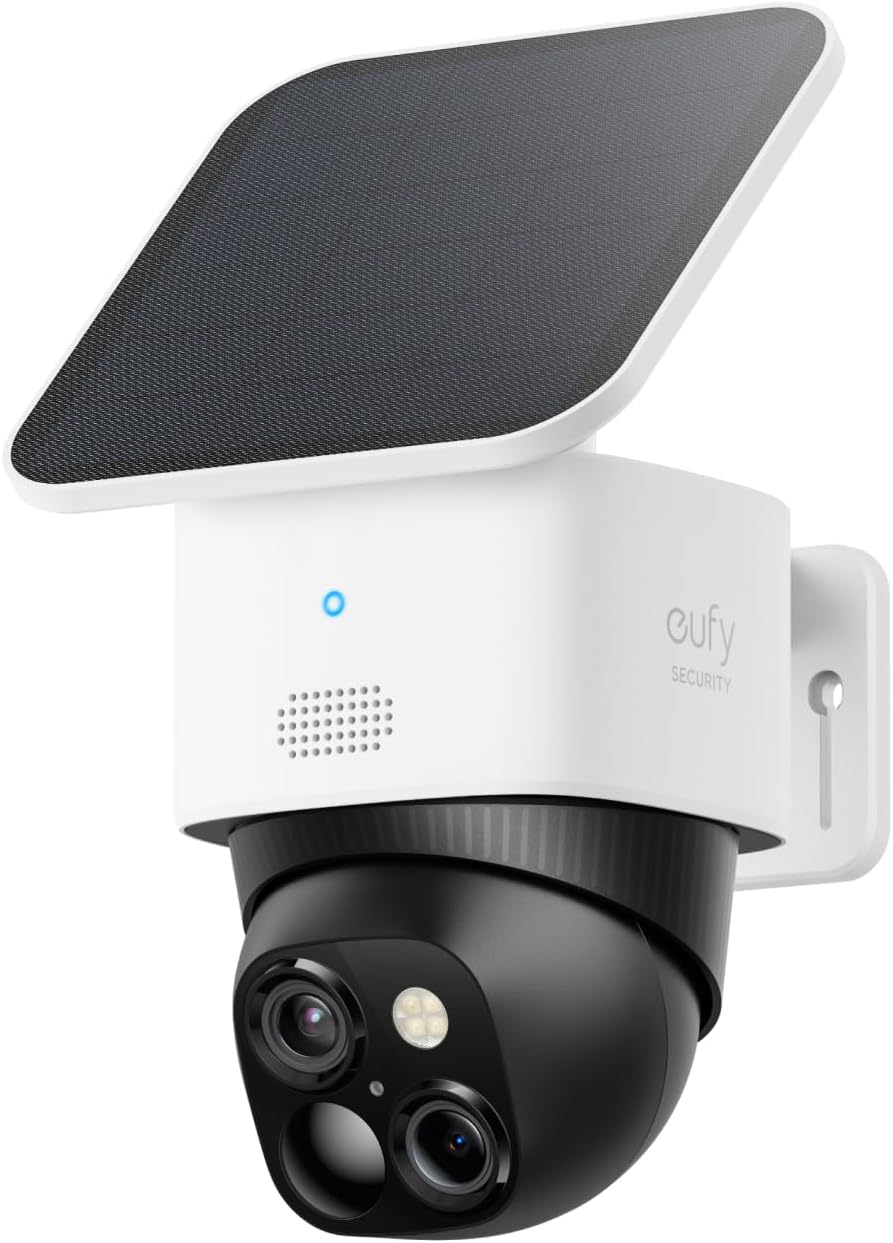
Eufy SoloCam S340
Why We Love It (Pros & Cons)
Pros
- Crystal clear 4k video
- Easy solar setup
Cons
- App can be slow
Eufy SoloCam S340 Specs
| Specification | Detail |
|---|---|
| Primary Resolution | 3K 2880 x 1620 pixels (Wide-Angle) |
| Secondary Resolution | 2K 2304 x 1296 pixels (Telephoto) |
| Field of View | 135 degrees (Wide-Angle) |
| Aperture | f/1.6 (Both Lenses) |
| Optical Zoom | 3x (Telephoto); 8x Hybrid Total |
| Pan / Tilt Range | 360 degrees Pan / 70 degrees Tilt |
| Night Vision | IR (15m) + Color Spotlight (100 lumens) |
| Battery Capacity | 10,000 mAh Built-in Lithium-Ion (Non-Removable) |
| Battery Life (No Solar) | Up to 3 months |
| Solar Panel | 2.2W SolarPlus 2.0, 4.72 x 4.72 inches, 4.5 oz |
| Minimum Charging Light | 2,500 Lux |
| Daily Solar Harvest | 800 to 1,200 mAh (Optimal) |
| Daily Power Consumption | 100 to 200 mAh |
| Local Storage | 8GB eMMC (Built-In, No Subscription) |
| Expandable Storage | Up to 16TB via HomeBase 3 (Sold Separately) |
| Wi-Fi | 2.4 GHz Only (No 5 GHz) |
| Weather Rating | IP67 (Dust-Proof, Immersion-Resistant) |
| Operating Temperature | -4°F to 122°F (-20°C to 50°C) |
| Camera Weight | 320 g (17.8 oz) Body Only |
| Dimensions | 96.5 x 81 x 57.5 mm |
| Voice Assistants | Amazon Alexa, Google Chromecast (Streaming Only) |
| MSRP | ~$199.99 (Single Camera) |
Eufy SoloCam S340 Dual-Lens Optical System
The dual-lens setup is the S340’s most significant engineering departure from competing solar cameras. Most budget and mid-range solar cameras use a single fixed lens with digital zoom, which degrades image quality significantly when zoomed in. The S340 uses two physically separate, fixed lenses: a 3K wide-angle and a 2K telephoto, mounted together in a single motorized housing.
Primary Wide-Angle Lens (3K)
The wide-angle lens captures a 135-degree field of view at 2880 x 1620 pixels. This FOV is wide enough to monitor intersecting planes of a property,y such as the corner of a house covering both a driveway and a side yard, without the barrel distortion common in ultra-wide lenses. This lens handles initial motion detection and scene-level monitoring.
Secondary Telephoto Lens (2K)
The telephoto lens provides a 3x optical zoom over the wide-angle baseline, recording at 2304 x 1296 pixels. Combined with digital interpolation, this produces an 8x hybrid zoom capability. Because the base magnification is optical rather than digital, the S340 retains legible detail, including facial features and license plate alphanumerics, at distances up to 50 feet (15 meters) during daylight. Pure digital zoom systems stretch and degrade pixels at this range.
f/1.6 Aperture and Low-Light Advantage
Both lenses share an f/1.6 aperture, which is unusually large for a camera in this price tier. A wider aperture allows approximately 20% more light to reach the sensor compared to the f/2.0 lenses common in competing hardware. In practical terms, this means the camera can accurately classify objects and track motion deeper into twilight before the energy-intensive spotlight needs to activate, an important benefit for a solar-powered device managing battery consumption.
Dual View: Simultaneous Wide and Zoomed Recording
The S340 can process and display both lens feeds simultaneously through a Dual View mode. This addresses a well-known flaw in standard PTZ cameras: when a single-lens camera zooms in to track a subject, it loses the wider field of view entirely. With Dual View, the S340 can capture close-up detail of a tracked subject via the telephoto lens while the wide-angle lens continues recording the broader scene.
One important practical note: Dual Mode compresses both feeds into a single 2304 x 2592 video, which noticeably reduces image quality. For live monitoring and event recording, using either the telephoto or the wide-angle lens independently yields sharper results.
Night Vision Performance on the Eufy SoloCam S340
The S340 offers two distinct night vision modes that serve different purposes.
- Standard IR Night Vision: A 0-lux infrared LED array provides a reach of up to 15 meters (approximately 49 feet) in complete darkness. This mode produces black-and-white footage and operates covertly, without any visible light that could alert an intruder to the camera’s position.
- Color Night Vision via Spotlight: A built-in white LED spotlight emits 100 lumens of visible light when motion is detected. This activates full-color recording, which is significantly more useful for forensic identification. Clothing color, vehicle paint, and facial detail are all visible in color footage. The 100-lumen output also serves as a psychological deterrent. The f/1.6 aperture works synergistically with the spotlight to maximize color accuracy.
Users can configure the camera to operate in IR-only mode, spotlight-only mode, or switch automatically based on ambient light levels.
360-Degree Pan and Tilt Coverage
The S340’s motorized gimbal provides 360-degree horizontal panning and 70-degree vertical tilt. In practice, the combination of a 355-degree mechanical rotation range and the camera’s 135-degree optical field of view produces effective full-perimeter coverage with no spatial blind spots, provided the camera is mounted at the manufacturer’s recommended height of 7 to 10 feet above ground.
Preset Positions and Auto-Cruise
Users can save up to four preset positions, such as a front gate, side path, and driveway, directly in the app. Tapping a preset instantly rotates the camera to those exact coordinates without manual adjustment. These presets can also be chained into an Auto-Cruise sequence, where the camera autonomously rotates between all saved positions on a continuous patrol cycle.
The home position feature is particularly important for event-triggered recording. After each motion event or a short period of inactivity, the camera automatically returns to the default home position rather than remaining pointed wherever the tracking algorithm left it. This ensures the camera is always ready in the correct direction.
AI Auto-Tracking
When a subject is detected, the camera locks on and follows them across the frame using a closed-loop motor control system. The telephoto lens simultaneously captures close-up detail of the tracked subject while the wide-angle continues monitoring the broader area. One practical limitation: the tracking algorithm prioritizes the first detected subject. If a second person enters the frame moving in the opposite direction, the camera does not split its attention and will continue tracking the original subject.
Dynamic Privacy Masking
Up to four privacy zones can be configured to permanently block specific areas, such as a neighbor’s window, from being recorded. Unlike fixed-lens cameras, where a static digital box suffices, a PTZ camera’s privacy masking must physically follow the camera’s rotation. The S340’s firmware tracks the exact stepper motor coordinates at all times and dynamically repositions the privacy mask across the video feed to maintain alignment with the physical space, regardless of pan angle. The masking area intentionally expands slightly during fast-tracking movements to prevent any gaps.
Eufy SoloCam S340 Solar Charging System
The S340’s power system is designed to eliminate the recurring maintenance overhead of standard battery cameras. The combination of a large internal battery and a high-efficiency solar panel is the most important practical feature for most buyers.
Battery Capacity and Standalone Runtime
The built-in non-removable lithium-ion battery holds 10,000 mAh. Under typical operating conditions, moderate daily motion events, AI processing, and clip recording, the camera consumes 100 to 200 mAh per day, representing approximately 1 to 2 percent of total capacity. Without any solar input, this reserve supports up to three months of continuous operation.
The oversized battery capacity is a deliberate engineering choice. In cold climates where lithium-ion chemistry degrades in efficiency and solar output is reduced, a larger reserve provides an essential operational buffer. Real-world testing at -17°C (-1.4°F) showed the camera maintaining approximately 95 percent charge throughout winter when receiving minimal solar trickle charging.
SolarPlus 2.0 Panel Performance
The included 2.2-watt solar panel uses Eufy’s SolarPlus 2.0 technology and begins charging at just 2,500 Lux of ambient light, significantly lower than the 10,000 Lux minimum required by most competing solar camera panels. Two hours of direct sunlight per day provides enough energy to cover a full 24-hour operating cycle. Under optimal conditions, the panel harvests 800 to 1,200 mAh daily.
When comparing daily generation to daily consumption, the panel can produce up to six times more power than the camera uses on a clear day. This surplus rapidly tops up the battery, keeping it at full capacity. The panel also includes bypass diodes that allow it to continue charging at up to 60 percent capacity even when partially shaded by leaves or debris, preventing the complete output failure common in cheaper solar panels.
Flexible Panel Mounting
The solar panel can be mounted directly on top of the camera housing or detached and positioned up to 10 feet (3 meters) away via the included USB-C extension cable. This is practically useful when the camera is mounted under a shaded eave: the panel can be routed to a sun-exposed section of the roof while the camera stays in an optimal monitoring position.
Motion Detection and AI on the Eufy SoloCam S340
PIR Sensor Ranges
Before the AI processor or camera sensor activates, a Passive Infrared (PIR) sensor handles initial motion detection by identifying rapid changes in thermal signatures. At the default sensitivity level of 4, the detection range is 20 to 26 feet (6 to 8 meters) during daylight and 13 to 20 feet (4 to 6 meters) at night. At maximum sensitivity, real-world user testing demonstrates reliable detection at 40 to 45 feet, a notably wide range that makes the S340 viable for monitoring long driveways and large backyards.
On-Device AI Classification
The S340 runs human detection, vehicle detection, and pet detection natively on its built-in System on a Chip, without sending video to the cloud. This edge-AI approach provides low-latency alerts and preserves privacy. The classification layer filters out environmental triggers such as swaying branches and passing shadows, reducing false-positive notifications significantly.
BionicMind with HomeBase 3
When paired with the Eufy HomeBase 3 (S380, firmware V3.3.2.6 or above), the camera gains access to the BionicMind AI suite. This upgrades categorical detection (“a person is present”) to individual recognition (“John is present”). The system learns to identify familiar faces and authorized vehicles over time, allowing users to receive alerts only for unrecognized individuals while suppressing notifications for known household members. This significantly reduces alert fatigue in busy households.
Nighttime Activity Zone Override Important Limitation
A documented firmware behavior affects users living near busy roads or other high-traffic areas. During nighttime hours, the camera’s firmware overrides user-configured Activity Zones. While push notifications are still suppressed for out-of-zone motion, the camera hardware physically wakes up, runs AI classification, activates illumination, and writes the event to local storage. For cameras pointed near a busy road, this causes continuous overnight recording of passing headlights, draining the battery faster than expected, and filling the 8GB internal storage rapidly. Users in these environments should consider pairing with a HomeBase 3 to manage storage overflow, and orient the camera’s home position away from high-traffic areas.
Storage Options for the Wireless Outdoor Security Camera
Built-In 8GB eMMC
All video clips are stored locally on 8GB of eMMC flash memory soldered to the camera’s mainboard. There is no microSD slot. At standard recording bitrates, 8GB stores several days to a couple of weeks of motion-triggered clips before older footage begins overwriting. The primary vulnerability of this approach is that if the camera is stolen or destroyed, the forensic footage is lost with it.
HomeBase 3 Network Storage (Up to 16TB)
The HomeBase 3 hub accepts a user-supplied 2.5-inch hard drive or SSD and provides up to 16TB of encrypted local network storage. When paired, the S340 redirects encrypted video streams to the HomeBase 3 inside the home, protecting footage from physical camera theft. The HomeBase 3 also manages the nighttime Activity Zone overflow issue, intelligently handling event storage without overloading the camera’s on-board eMMC.
Bundled kits with the HomeBase 3 are available starting at approximately $349.99.
Cloud Subscription (Optional)
Eufy offers optional cloud storage plans for users who want off-site backup. A Basic plan covers one camera for $3 per month or $30 per year with 30 days of recordings. A Premier plan covers up to 10 cameras for $10 per month or $100 per year. These plans are entirely optional; the camera functions fully with local storage only.
Installation and Setup
The S340 is designed for a straightforward DIY installation. Most users complete the full process in 5 to 10 minutes per camera. The wire-free design eliminates the need for electricians, conduit runs, or junction boxes.
- Mounting: A 15/64-inch (5.95mm) drill bit is required to set the wall or ceiling anchors for the mounting bracket. The camera slides onto the bracket and locks in place.
- Orientation: The camera must be wall or ceiling-mounted. The app does not provide a video inversion option, so it cannot be used as a tabletop unit or mounted upside down from a ceiling without producing an inverted image.
- Recommended Height: Mount between 7 and 10 feet above ground so the 70-degree downward tilt covers the area directly beneath the camera.
- Solar Panel: Charge the camera fully before connecting the solar panel. The panel can then be mounted directly on the camera or positioned separately in a sun-exposed location.
- App Setup: The eufy Security app guides you through Wi-Fi pairing. The camera connects to 2.4 GHz networks only. Setup requires an active Wi-Fi connection; once configured, the camera can continue recording locally without internet access.
One common installation complaint from reviewers involves the included screw hardware: the heads can strip during installation. Using your own hardware of equivalent size avoids this issue.
App, Smart Home Integration, and Ecosystem Limits
The eufy Security app provides full control over the S340: live view, PTZ joystick, preset management, motion zone configuration, notification scheduling, and image quality settings. The interface is functional, though some users find it slightly cluttered.
Voice assistant support extends to Amazon Alexa (Echo Show streaming) and Google Chromecast. The camera does not support Alexa or Google Home for voice commands, only video streaming. There is no Apple HomeKit, HomeKit Secure Video, Matter, or IFTTT support.
The S340 does not support RTSP output or third-party NAS integration. Users who want to route camera feeds into platforms like Blue Iris, Synology Surveillance Station, or QNAP will find the S340 incompatible. This is a deliberate design restriction rather than a hardware limitation, and it means expanded storage and advanced AI features require purchasing Eufy’s own HomeBase 3.
The 2.4 GHz-only Wi-Fi is appropriate for outdoor cameras. The longer wavelength penetrates exterior walls, brick, and insulation far more reliably than 5 GHz, maintaining a stable connection from distant mounting points. The tradeoff is maximum theoretical bandwidth, which is not a constraint for motion-triggered clip recording.
Build Quality and Weather Resistance
The S340 carries an IP67 ingress protection rating. The “6” signifies full dust protection; the “7” means the unit can withstand submersion in up to 1 meter of water for 30 minutes. The PTZ motor seals, dual-lens gaskets, and USB-C charging port are all waterproofed to handle sustained heavy rain and blizzard conditions.
The camera is rated to operate from -4°F to 122°F (-20°C to 50°C). Field reports from Canadian users at -17°C confirm sustained operation through heavy snowfall and ice accumulation on the camera body and solar panel, with the 10,000 mAh battery and solar trickle charge maintaining the unit well above the critical low-battery threshold.
Eufy SoloCam S340 vs. Competing Solar Security Cameras
| Feature | S340 | SoloCam E30 | eufyCam S330 | Floodlight E340 |
|---|---|---|---|---|
| Resolution | 3K + 2K Dual | 2K Single | 4K Single | 3K + 2K Dual |
| Lens Type | Dual (Wide + Tele) | Single Wide | Single Wide | Dual (Wide + Tele) |
| Zoom | 8x Hybrid | 8x Digital | 8x Digital | 8x Hybrid |
| PTZ | 360° / 70° | 360° / 70° | Fixed | 360° / Tilt |
| Night Vision | IR + 100lm Color | IR Only | IR + Color | IR + 2000lm Color |
| Power | 10k mAh + 2.2W Solar | Battery + Solar | Battery + Solar | AC Hardwired Only |
| Standalone? | Yes (8GB eMMC) | Yes | No (HomeBase Required) | Yes (Wired) |
| MSRP (Approx) | $199.99 | $149.99 | Kit ~$549+ | N/A |
Against the E30: The $50 premium for the S340 over the E30 is justified by the addition of the telephoto lens and color night vision spotlight. The E30 cannot resolve license plates at 50 feet and produces only IR monochrome footage at night.
Against the eufyCam S330: The S330 records in 4K but uses a fixed lens and digital-only zoom. A single S340 covering 360 degrees can replace two S330 units on a corner mount. The S330 also cannot function as a standalone device; it requires a HomeBase 3 to operate, whereas the S340 works independently out of the box.
Against the Floodlight E340: The E340 shares the same dual-lens optical architecture but requires a permanent AC hardwired installation. Its 2,000-lumen floodlight far outperforms the S340’s 100-lumen spotlight for illumination. For locations with existing electrical infrastructure, the E340 is superior. For fences, trees, eaves, and unpowered walls, the S340 is the only practical option.
Pros and Cons of the Eufy SoloCam S340
Pros
- Truly wire-free with highly efficient solar charging that maintains a full battery in as little as 2 hours of daily sunlight
- The dual-lens system provides simultaneous wide-context and telephoto-detail recording, solving PTZ tunnel vision
- 360-degree coverage eliminates the need for multiple cameras on a single mounting point
- No mandatory subscription: 8GB local storage included at no ongoing cost
- On-device AI for human, vehicle, and pet detection with a low false-positive rate
- f/1.6 aperture on both lenses enables earlier nighttime classification and color recording
- IP67 weather rating and 10,000 mAh battery provide reliable cold-climate performance
- 5 to 10-minute DIY installation with flexible solar panel mounting
Cons
- 2.4 GHz Wi-Fi only, no 5 GHz support (acceptable for outdoor use, but worth confirming your router coverage)
- Dual-mode simultaneous recording degrades image quality significantly; single-lens modes are sharper
- PTZ tracking can lag on weak Wi-Fi connections
- Nighttime Activity Zone override can drain battery and fill storage for cameras near busy roads
- No RTSP, NAS, Apple HomeKit, Matter, or IFTTT support in an entirely closed ecosystem
- Expanding storage beyond 8GB requires purchasing the proprietary HomeBase 3 separately
- 12-month warranty does not reset on replacement units; warranty clock ties to original purchase date
- Firmware updates in early 2026 caused widespread connectivity failures requiring physical factory resets
Firmware Reliability: An Important Consideration
The S340 is a heavily software-dependent device, and firmware updates are delivered over-the-air with no option to decline. In early 2026, mandatory firmware updates in February and March caused widespread connectivity failures for users running the S340 with HomeBase 3. Issues included cameras disconnecting from the hub, live feeds displaying screenshot overlays from the wrong cameras, and stored video playback failing after 10 seconds. Resolution required a physical factory reset, which, for a camera mounted at height, means retrieving a ladder.
A subsequent update (version 3.3.3.8) inadvertently broke pet detection on the device. Eufy issued patches over the following weeks, but the incidents highlight an inherent risk in closed-ecosystem edge-AI devices: a single poorly tested firmware update can disable hardware that is otherwise functioning correctly.
This is not unique to Eufy, but it is worth factoring into your decision, particularly if you’re installing the camera in a location where physical access is difficult.
Who Should Buy the Eufy SoloCam S340 Wireless Solar Security Camera?
Best For
- Homeowners without electrical access at desired mounting locations, such as fences, trees, detached garages, and eaves
- Buyers who want 360-degree coverage from a single camera without running wires
- Households in regions with consistent sunlight that want genuinely maintenance-free outdoor security
- Users who prioritize privacy and want all footage stored locally with no mandatory cloud fees
- Those upgrading from Ring or Arlo who want to eliminate ongoing subscription costs
Not Ideal For
- Homes in heavily shaded environments where solar input is consistently low
- Users who need Apple HomeKit, RTSP, or third-party NAS integration
- Locations adjacent to busy roads, where the nighttime Activity Zone override will cause continuous false recordings
- Buyers with 5 GHz-only routers without a 2.4 GHz network available
Eufy SoloCam S340 Frequently Asked Questions
Does the Eufy SoloCam S340 work without Wi-Fi?
The S340 requires Wi-Fi for initial setup, remote access, live viewing, and motion notifications. Without Wi-Fi, the camera cannot be configured, and you will not receive alerts. However, once set up, the camera will continue recording locally to its 8GB internal storage even if the internet connection drops.
How long does the battery last without the solar panel?
Up to 3 months under average use conditions, defined as approximately 300 seconds of recording time per day. Battery life varies based on the frequency of motion events, recording duration, and ambient temperature. Cold weather reduces lithium-ion efficiency, but the 10,000 mAh reserve provides a substantial buffer.
Does the Eufy SoloCam S340 require a monthly subscription?
No. The camera stores footage locally to its 8GB built-in memory at no ongoing cost. Optional cloud plans are available starting at $3 per month per camera, but they are not required for full camera functionality.
Does the S340 need a HomeBase to work?
No. The S340 is fully functional as a standalone camera using its 8GB internal storage. Pairing with the HomeBase 3 adds BionicMind facial recognition, cross-camera tracking, and up to 16TB of expanded local storage, but none of these are required for basic operation.
What is the detection range of the Eufy SoloCam S340?
At default sensitivity (level 4), the PIR detection range is 20 to 26 feet during the day and 13 to 20 feet at night. At maximum sensitivity, real-world testing shows reliable detection at 40 to 45 feet.
Does it work with Alexa or Google Home?
The S340 supports video streaming to Amazon Echo Show devices and Google Chromecast. It does not support Alexa or Google Home for voice commands. Apple HomeKit is not supported.
How much sunlight does the solar panel need each day?
Eufy states that 2 hours of direct sunlight per day provides enough energy to power the camera for a full 24-hour cycle. The SolarPlus 2.0 panel begins charging at 2,500 Lux of ambient light, which is well below the threshold needed for most daylight conditions.
Can the Eufy SoloCam S340 record continuously?
No. The S340 uses motion-triggered event recording only. Continuous 24/7 recording is not supported, even when paired with the HomeBase 3. This is a function of both battery management and 2.4 GHz bandwidth limitations.
Is the S340 compatible with RTSP or NAS storage?
No. The S340 does not support RTSP output and cannot stream to third-party NAS devices such as Synology or QNAP systems. Expanded storage requires Eufy’s own HomeBase 3.
Final Verdict
The Eufy SoloCam S340 is one of the most technically capable wireless outdoor solar security cameras available at its price point. The dual-lens optical system solves real problems; it delivers simultaneous contextual and close-up recording that single-lens PTZ cameras cannot match. The 10,000 mAh battery and SolarPlus 2.0 panel make it genuinely maintenance-free in most climates, and the no-subscription local storage model saves meaningful money over time compared to Ring or Arlo subscriptions.
The trade-offs are real but manageable for most buyers. The closed ecosystem means no RTSP, no HomeKit, and no NAS. If these matter to you, the S340 is not the right camera. The nighttime Activity Zone override is a genuine firmware quirk that affects users near busy roads. And the early 2026 firmware failures are a reminder that edge-AI security cameras carry software risk that traditional CCTV does not.
For homeowners who want wire-free installation, complete 360-degree coverage from a single unit, reliable solar charging, and no recurring fees, the S340 delivers on its core promises. It is a strong buy for the right use case.